
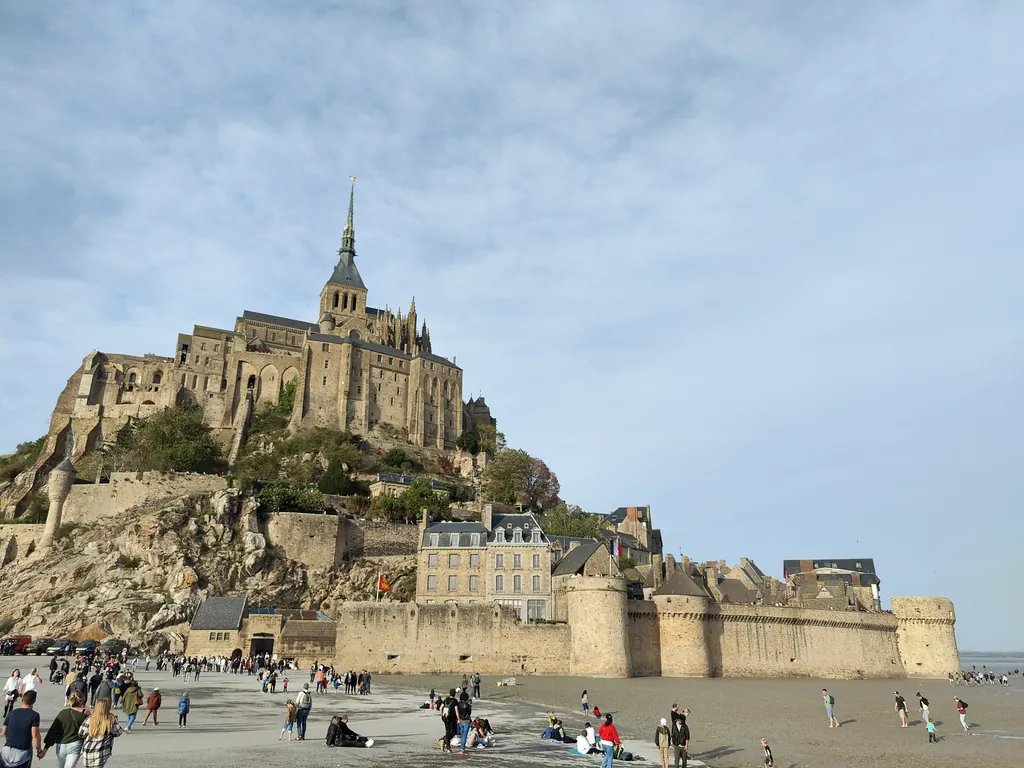
Walking out to Mont-Saint-Michel across the seabed — barefoot, the way pilgrims did for centuries — rather than over the bridge is one of the most memorable experiences in Normandy. But the bay is no beach for a stroll: it has some of the fastest tides in Europe, quicksand, and fog that can wipe out the shoreline in minutes. So the rule is simple, with no exceptions: you cross the bay only with a licensed guide. Here's how a crossing works, why you must never go alone, what to bring and how to book.
The crossing is the approach to the island. The Mont itself begins at the gate: once you're across, the self-guided TouringBee island audio guide takes over for the village and the ramparts — an offline map and a story at every stop.
In short
- Never cross alone — only with a certified guide (guide attesté / accompagnateur).
- This isn't a scare story: the fast tide, the quicksand (lises) and the fog are genuinely dangerous.
- Crossings are timed to the tide, not to convenience — the water sets the day and the hour.
- You walk barefoot with your trousers rolled up; bring a towel and shoes for afterwards.
- Book ahead: timing follows low tide, groups fill up, and the guide won't wait for latecomers.
Why you must never cross alone
The bay looks deceptively calm — a wide, flat expanse you could apparently just walk across to the island. In reality several dangers meet here, and each one alone is serious.
- The tide. The tidal range here is one of the largest in Europe. The water comes back across an almost flat seabed very fast and fills the channels behind you first, quietly cutting off the way back. The old line about the sea arriving "as fast as a galloping horse" exaggerates the speed, but not the danger: by some estimates, on open stretches the tide advances at up to several dozen metres a minute.
- Quicksand (locally, lises). In places, waterlogged sand turns into a trap: your foot sinks and stays put. This is no tourist myth — for centuries the bay was the fortress's natural defence. The famous medieval Bayeux Tapestry shows William the Conqueror's soldiers getting stuck in the quicksand at the foot of the Mont, and besieging armies could never dig in beneath the walls because the mud around the island was riddled with hidden sinking sand. With a guide these patches are manageable — even part of the experience, as the guide shows them to you on purpose. Alone, with the water coming in, they are genuinely dangerous.
- Fog and channels. Visibility in the bay can vanish in minutes, landmarks disappear, and the river beds (the Couesnon, Sée and Sélune) and gullies shift from one tide to the next. The safe path today is not the one it was yesterday.
That's why bay guiding has been a profession here for centuries, and why crossing with a certified guide is the only safe way to do it.
What a guided crossing is
It isn't the same as walking to the island over the bridge. A bay crossing is a separate adventure on foot across the seabed: you walk barefoot over sand and silt (locally tangue), wade shallow channels, and along the way the guide points out the quicksand, reads the traces of the tides and explains how the bay works. Many routes end at the Mont itself, or head out to the islet of Tombelaine, a bird sanctuary opposite.
Groups are led by certified guides, and the activity is officially regulated in France. Choose an operator with licensed guides — through the bay's tourist office or a trusted booking platform.
Routes and how long they take
There are several formats, and the timing depends on the route and the tides — confirm the exact figures with the operator for your date:
| Format | Roughly how long | Good for |
|---|---|---|
| Short bay walk | about 2–2.5 hours, a few km | a first taste, families with children |
| Half-day crossing | around 3–5 hours, some 12–15 km | the classic experience |
| Grand crossing from Genêts | about 6–6.5 hours | fit walkers who want the full traverse |
There are night crossings too, from the Bec d'Andaine. Prices vary a lot by format and operator — roughly €10 to €36 per person, less for children. Check the exact terms with the operator.
Where crossings start
The meeting point depends on the operator and the route, and it's worth confirming in advance:
- Genêts / Bec d'Andaine (Maison de la Baie) on the Normandy side — the classic "big" crossings.
- Saint-Léonard / Pointe du Grouin du Sud (Vains) — a separate start area with a dedicated "Départ traversées" car park.
- Some short walks start from Mont-Saint-Michel itself.
Many operators ask you to get in touch the day before to confirm the exact meeting point — don't skip this step.
What to bring and wear
- You go barefoot and bare-legged — sand, silt and channels are part of the route. Roll your trousers up high or wear shorts.
- In your backpack: a towel and shoes to change into afterwards, water, and a windbreaker (the bay is almost always windy, even in summer).
- Be in reasonable physical shape; children only with an adult and on a route of suitable length.
- Leave behind anything you'd mind getting muddy or wet.
When to go and how to book
The water sets the timetable: crossings are scheduled around low tide, so the time changes every day, and the season runs mainly from spring to autumn. In practice:
- Book ahead — group sizes are capped, and good dates sell out. Walk-ups are sometimes possible up to half an hour before the start if there's room, but don't count on it.
- Arrive early (15–20 minutes): the timing follows the tide, and the guide doesn't wait for latecomers.
- Check the tide calendar so you understand why the start is at that particular hour — there's more in our tides guide.
Book a crossing with a licensed guide
Guided bay walks and crossings, with times set by the tide — compare and reserve ahead.
After the crossing: the island itself
The crossing is unforgettable, but it's only the approach. Once you're at the gate, the second half of the day begins — the Mont itself: the Grande Rue, the abbey at the top, the ramparts. To cover the whole island with its stories, rather than just "walk up and back," take the self-guided TouringBee island audio guide: 17 stops in the right order, an offline GPS map (the signal on the island is unreliable) and stories written by local historians that you start yourself at each spot. This is where tales like the quicksand on the Bayeux Tapestry, the fortress that was never taken, and the great treadwheel medieval builders used to haul stone come alive. One payment, a year's access, several languages.
For how the island itself is laid out, see our map and walking route.
Walk Mont-Saint-Michel at your own pace
17 stops, an offline GPS route, stories written by local historians — a route of about 2 hours.
Get the audio guide — from €9.99~2-hour route · offline · one payment · 1 year access
Safety, once more (on purpose)
- Never head out into the bay without a certified guide — not "just a short walk," not "only to the nearest sandbank."
- Don't follow people you see in the distance: you don't know whether they're with a guide or what the tide is doing.
- If you're with a guide, listen to them and stay with the group — they know the quicksand and the channels; you don't.
Frequently asked questions
Can I walk to Mont-Saint-Michel across the bay on my own?
No. Because of the fast tides, quicksand and fog, the bay is crossed only with a certified guide. If you simply want to reach the island, take the bridge (the passerelle) or the free shuttle.
Is the quicksand in the bay dangerous?
Yes, in places. In the Middle Ages it was even part of the fortress's natural defence. With a guide it's manageable and part of the experience; alone it's a real danger, especially with the tide coming in.
How long does a crossing take?
It depends on the route: a short walk takes about 2–2.5 hours, a half-day crossing about 3–5 hours, and the grand crossing from Genêts around 6 hours. Confirm the exact time with the operator for your date.
Do I have to go barefoot?
Almost always — it's sand, silt and channels. Bring a towel and shoes to change into afterwards.
When is the best time to go?
Mainly from spring to autumn; the exact hour is set by low tide, so it changes every day. Check the tide calendar and book ahead.
Continue planning
The takeaway
Crossing the bay is perhaps the most powerful way to arrive at Mont-Saint-Michel: barefoot across the seabed, like the pilgrims centuries ago. But the bay forgives only those who respect its rules — the fast tide, the quicksand and the fog make crossing alone genuinely dangerous. Go with a certified guide, book ahead, dress for sand and water, and it becomes an experience you'll remember for years.
And when the crossing brings you to the gate, let the island take it from there — at your own pace, with all its stories.
Some links on this page are affiliate or product links (GetYourGuide, TouringBee). If you buy through them we may earn a small commission — at no extra cost to you. It never affects what we recommend. See our Affiliate Disclosure.