
Mont-Saint-Michel is thirteen centuries packed onto one granite rock: a bishop's vision, a Benedictine monastery, a Gothic "Marvel" over a cliff, a fortress the English never took, a prison and, finally, one of the most visited monuments in France. Its story is full of legends, and they are part of the place — but the facts are just as remarkable. Here, briefly and in order: what really happened, where the legend begins, and what you can still see today.
History is worth reading before you go, but it's more vivid on the spot, beside the walls themselves. The self-guided TouringBee island audio guide tells these stories on the way from the town gate up to the abbey: 17 stops, an offline map, and stories you start yourself.
In short: a timeline
| Year | What happened |
|---|---|
| 708 | Bishop Aubert of Avranches, after a vision of the archangel Michael according to tradition, founds a sanctuary on the rock of Mont-Tombe |
| 966 | Richard I, Duke of Normandy, hands the mount to Benedictine monks |
| 11th century | A Romanesque abbey church rises on the summit, set on a platform of crypts |
| 1204 | Fire during Philip II Augustus's war for Normandy |
| 1211–1228 | The Gothic complex of La Merveille ("the Marvel") is built |
| 1434 | The garrison beats back the decisive English assault; the fortress is never taken in the Hundred Years' War |
| 1790s–1863 | After the Revolution the monks are expelled and the abbey becomes a prison |
| 1874 | The abbey is listed as a historic monument and restoration begins |
| 1897 | Emmanuel Frémiet's gilded statue of Saint Michael is raised onto the spire |
| 1979 | Mont-Saint-Michel and its bay become a UNESCO World Heritage Site |
| 2014 | A new bridge opens, letting the sea surround the island again |
How it began: Bishop Aubert and the archangel
The Christian story of the mount begins with a legend. In 708 the archangel Michael appeared in a dream to Aubert, bishop of nearby Avranches, and told him to build a sanctuary on the rock. Aubert hesitated — and, the story goes, after the third visit the archangel touched his head with a finger, leaving a mark. A skull with a hole in it is still kept in the basilica of Saint-Gervais in Avranches and shown as a relic. Whatever you make of it, Aubert built a small sanctuary, and the rock then called Mont-Tombe became the mount of Saint Michael.
Another legend follows close behind: that the rock was once surrounded by the dense forest of Scissy, which the sea one day swallowed. It's a lovely tale rather than an established fact — but it captures why, for centuries, people saw the bay as a place where sea and land argue with each other.
Monks and Normandy
In 966 Richard I, Duke of Normandy, gave the mount to Benedictine monks, and from then on it was not only a shrine but an important point on the border between Normandy and Brittany. Gifts, books and pilgrims flowed in, and over time the monastery's library became one of the best known in the region.
How to build an abbey on a sharp rock
The main engineering problem was simple and almost impossible: the top of the granite rock was too narrow and pointed for a large church. Medieval builders solved it their own way — they built underground churches, crypts, around the summit, and set the Romanesque church on the platform they created. Stone came by water, some of it from the Chausey islands, with the work timed to the tides, and it was hauled up with hoists. The great wooden treadwheel shown in the abbey dates from the later prison years of the 19th century, but it shows well how loads were lifted up this rock for centuries.
The Bayeux Tapestry: quicksand at the foot of the mount
Mont-Saint-Michel even appears on the famous Bayeux Tapestry. In the scene of William's (the future Conqueror's) Breton campaign, the army crosses the River Couesnon at the foot of the mount, and Harold pulls several soldiers out of the quicksand. It's one of the earliest images of the very dangers of the bay that people are still warned about today. For how to walk the bay safely now, see our guide to crossing the bay.
La Merveille: a Gothic marvel after the fire
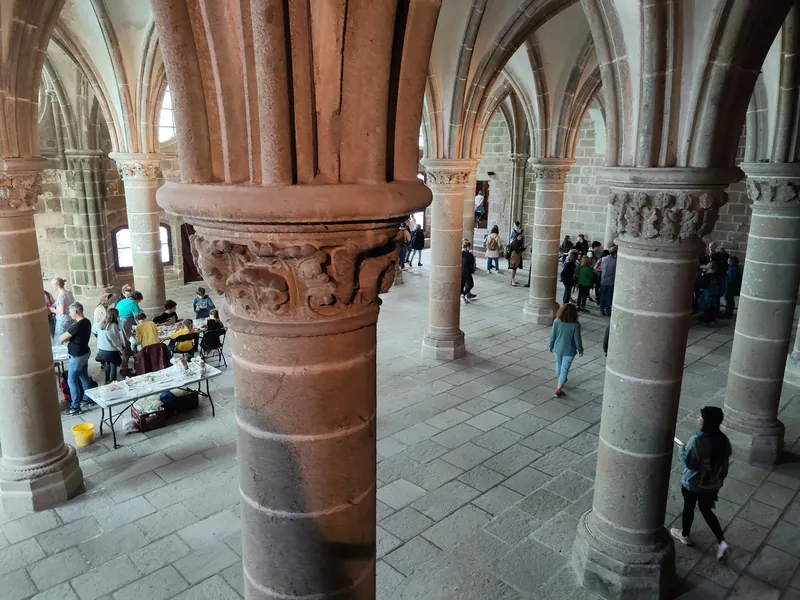
In 1204, during the French king Philip II Augustus's war for Normandy, the monastery was badly damaged by fire. The rebuilding produced one of the boldest buildings of its time — La Merveille, three Gothic storeys set right against the north slope of the rock. At the bottom, poor pilgrims were fed and supplies stored; in the middle, noble guests were received and monks worked; at the top are the refectory and the cloister, a garden gallery that seems to hang over the drop. For what it looks like inside and how to get in, see our abbey tickets guide.
Pilgrims: the miquelots and the road across the bay
For a thousand years Mont-Saint-Michel was one of the great pilgrimage centres of the Christian West. Its pilgrims were called miquelots. Many walked the last stretch across the seabed at low tide — and it was genuinely dangerous: fog, a fast tide and quicksand. That's why guiding across the bay has been a profession here for centuries. In the 14th and 15th centuries even groups of children and teenagers made the journey to the mount; these pilgrimages are well known from medieval chronicles.
The fortress that was never taken
During the Hundred Years' War, Mont-Saint-Michel was fortified with walls and towers. When almost all of Normandy had fallen to the English, the mount held out. The decisive assault was beaten back in 1434: according to tradition, the fortress was defended by 119 knights under Louis d'Estouteville. The English retreated and left two huge bombards beneath the walls — known as the michelettes — and you can still see English guns at the entrance to the village today. The fortress was never taken in the whole war, and for France the mount became a symbol of resistance.
The prison: the "Bastille of the seas"
The darkest chapter began after the French Revolution. The monks were expelled and the abbey turned into a prison, nicknamed the "Bastille of the seas." In the Gothic halls where monks had prayed, prisoners were held for decades, political ones among them — including the republicans Armand Barbès and Auguste Blanqui. The prison was closed in 1863 by decision of Napoleon III, but by then the buildings were badly damaged.
Revival: restoration and the archangel on the spire
In 1874 the abbey was listed as a historic monument, and a long restoration began. In 1879 a causeway was built to the island — it made the journey easier but, over time, caused the bay to silt up. In 1897 the abbey's spire was crowned with the gilded statue of the archangel Michael by the sculptor Emmanuel Frémiet — the figure you can see from far across the bay.
The Mont today
In 1979 Mont-Saint-Michel and its bay were added to UNESCO's World Heritage list. Monastic life returned to the abbey in the second half of the 20th century; since 2001 the brothers and sisters of the Monastic Fraternities of Jerusalem have lived here, and their daily services are open to visitors. And in 2014 the old causeway was replaced by a light bridge on piles: the water can move freely around the rock again, and on big tides the Mont becomes an island once more. For how and when to see it, see our tides guide.
Legends worth knowing
- Tombelaine. According to medieval legend, the neighbouring islet takes its name from the "tomb of Helen" — a young woman killed by a giant whom King Arthur then defeated. It comes from medieval chronicles, but it still lives on in the name.
- The galloping horse. People say the tide here "comes in as fast as a galloping horse." That's an exaggeration: on average the water moves at about a brisk walking pace. But the danger is real.
- The archangel and the dragon. Saint Michael is the dragon-slayer, which is why his sanctuaries often stand on high places, peaks and rocks. Mont-Saint-Michel is the most famous of them.
History on the spot
Dates and names are easy to read but harder to picture in front of the stone. On the island these stories come alive: the gate the pilgrims passed through, the walls the English fell back from, and at the top the abbey where monks prayed and, later, prisoners were held. The self-guided TouringBee audio guide tells the island's stories on the way from the town gates up to the abbey and along the ramparts — 17 stops, a route of about 2 hours, an offline GPS map. The stories are written by local historians and expert guides, and you start them yourself when you reach each spot. One payment, a year's access, 8 languages. Abbey entry is not included. More about how it works on our audio guide page.
Walk the island's history at your own pace
17 stops, an offline GPS route, stories written by local historians — about 2 hours.
Audio guide — from €9.99~2-hour route · offline · one payment · 1 year access
Frequently asked questions
Why was Mont-Saint-Michel built on a rock in the middle of a bay?
According to tradition, the archangel Michael chose the spot in a vision to Bishop Aubert in 708. An isolated rock suited a sanctuary and, later, a fortress: the tides and quicksand protected the approach.
Is it true the English never took Mont-Saint-Michel?
Yes. During the Hundred Years' War the mount withstood several sieges, and the decisive assault of 1434 was beaten back. English bombards left by the besiegers still stand at the entrance to the village.
Was Mont-Saint-Michel a prison?
Yes. After the French Revolution the abbey was turned into a prison, which closed in 1863. Restoration and the return of the monument to its former appearance followed.
Do monks live in the abbey today?
Yes. Since 2001 the brothers and sisters of the Monastic Fraternities of Jerusalem have lived in the abbey; their daily services are open to visitors.
What is La Merveille?
A 13th-century Gothic complex on the north side of the rock: three storeys of halls built after the fire of 1204, with the cloister and refectory at the top.
Continue exploring
The takeaway
The history of Mont-Saint-Michel is a rare case where legend and fact don't get in each other's way: a bishop's vision and a pierced skull, an engineering answer to a sharp rock, a Marvel over the cliff, an unconquered fortress and decades as a prison. All of it can still be seen on the island — you just need to know where to look. Read the timeline before you go, and on the spot walk the island with all its stories, at your own pace.
Some links on this page are product links to the TouringBee audio guide. See our Affiliate Disclosure.